
Watch a toddler try to “cut” a banana with a plastic play knife sometime. It bends. It slides off. Nothing happens, and the kid knows it. Then hand that same toddler a butter knife and a banana half, and something shifts. The tool does what it’s supposed to do. The kid does something real.
That’s the whole case for real tools over toy ones, honestly. Toy versions are safe because they’re powerless. They can’t cut, hammer, or build anything, so there’s no risk and also no actual skill being built. A real tool, sized and matched to a child’s ability, lets them do a genuine version of a genuine task. That’s a different kind of learning than pretend play, and it’s worth being deliberate about.
The reasoning behind it
This isn’t a new idea. Montessori classrooms have used child-sized real tools since Maria Montessori’s earliest schools, and the “practical life” area (pouring, spooning, buttoning, food prep) is core to the method, not a side activity. A 2017 action research study out of the University of Wisconsin-River Falls measured pincer grip in Montessori pre-K and kindergarten students before and after five weeks of practical life work, and found measurable gains in fine motor ability tied to using those real materials (University of Wisconsin-River Falls, Elcombe).
The reasoning shows up outside Montessori circles too. Reporting for NPR, journalist Eliza Barclay talked to Montessori educator Anna Perry, who described toddlers as young as 18 months learning to hold a butter knife correctly, hand on the handle, other hand steadying the food, well before most American kitchens let a kid near a blade. NPR also cited anthropologist David Lancy’s cross-cultural research, which found that in many non-Western communities, young children get access to real tools far earlier than is typical in the US, and that delaying it isn’t protecting development, it’s just delaying it (NPR, “Go Ahead, Give Your Toddler A Kitchen Knife”).
None of this means “hand a four-year-old a chef’s knife and walk away.” It means matching the real tool to the real ability, with real supervision, and letting the tool get sharper or more powerful as the kid gets more capable.
What that actually looks like, age by age
Occupational therapy assistant Heather Greutman at Growing Hands-On Kids lays out a knife-skills progression that’s a useful model for real-tool learning generally (Growing Hands-On Kids):
Around age 2: A butter knife or spreader for buttering toast or spreading jam. Soft foods like banana or avocado to practice a basic sawing motion. A “wavy chopper” style knife works too, since it fits a toddler’s whole-hand grasp.
Age 5-6: Kids typically have spreading down and are ready for a plastic serrated or nylon knife, sharp enough to cut through food, dull enough not to do serious harm to skin. This is also a reasonable age to introduce a real paring knife for soft fruit and vegetables, hand-over-hand at first.
Age 7 and up: Most kids can manage a knife and fork together to cut food on a plate, and with practice can move toward standard kitchen knives under direct supervision.
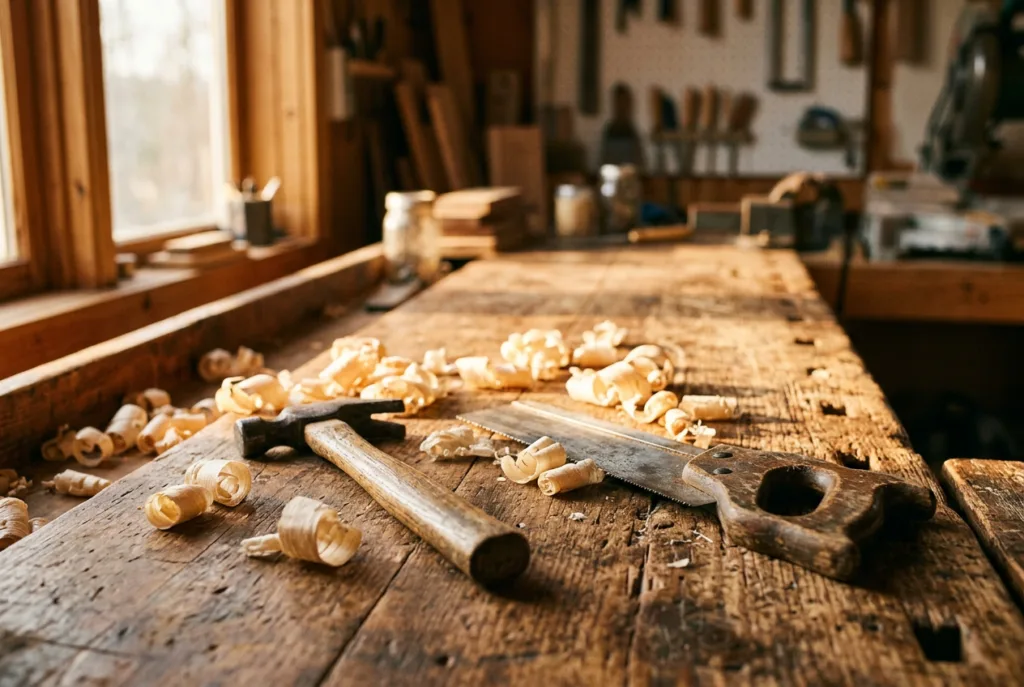
Outside the kitchen, Head Start of Lane County’s guidance for using real woodworking tools (hammers, saws, drills) in early childhood programs is a good safety framework for any home shop: one trained adult supervising no more than two children at a workbench at a time, safety glasses, soft woods like pine, hammers used for tapping rather than heavy driving at first, and tools checked before each use (Head Start of Lane County).
Chore-based tool use follows a similar arc. The American Academy of Child and Adolescent Psychiatry’s guidance has 4 and 5 year olds helping clear the table and feed pets, 6 and 7 year olds wiping counters and sweeping, and 7 to 9 year olds loading the dishwasher and helping with meal prep (AACAP, “Chores and Children”). The American Academy of Pediatrics’ parent site has 5 to 7 year olds packing lunches and washing dishes, 8 to 10 year olds helping make dinner, and 11 to 12 year olds cooking a simple meal with supervision (HealthyChildren.org).
Where to actually start
You don’t need a special “kids’ tool” purchase to begin. A butter knife from your own drawer, a child-size broom, a real hand whisk, a hammer meant for light tapping jobs, these are already in most homes. The starting point isn’t a product, it’s supervision and task-matching: pick something your child is close to being able to do, do it hand-over-hand a few times, then step back and let them try with you right there.
The goal isn’t independence for its own sake. It’s giving a kid’s hands something true to practice on, so the skill that develops is a real one.
Frequently Asked Questions
What age can kids start using a real knife?
Montessori programs commonly start toddlers as young as 18 months on a butter knife for spreading, per NPR’s reporting. Occupational therapy assistant guidance from Growing Hands-On Kids has kids moving to serrated or paring knives around age 5-6, and cutting food with a knife and fork independently around age 7.
Is giving young kids real tools actually safe?
It’s safe when it’s matched to the child’s ability and directly supervised. Head Start of Lane County’s tool-use policy for early childhood programs requires one trained adult per two children at a workbench, safety glasses, and tool checks before each use, a good model to borrow at home.
Does hands-on “practical life” work actually help development, or is it just cute?
A University of Wisconsin-River Falls action research study measured real gains in fine motor pincer-grip ability after five weeks of Montessori practical life activities in a pre-K/kindergarten classroom, which is direct evidence it’s doing more than looking nice on a shelf.
What’s a good first real tool to hand a toddler?
A butter knife or spreader with a soft food like banana or avocado is a common, low-risk starting point, per the age-by-age knife progression from Growing Hands-On Kids.
Sources
- NPR, “Go Ahead, Give Your Toddler A Kitchen Knife” (The Salt)
- Growing Hands-On Kids (Heather Greutman, COTA)
- University of Wisconsin-Madison MINDS@UW, Elizabeth Elcombe action research study
- Head Start of Lane County, “Tools in the Classroom”
- American Academy of Child and Adolescent Psychiatry, “Chores and Children”
- HealthyChildren.org (American Academy of Pediatrics)
