
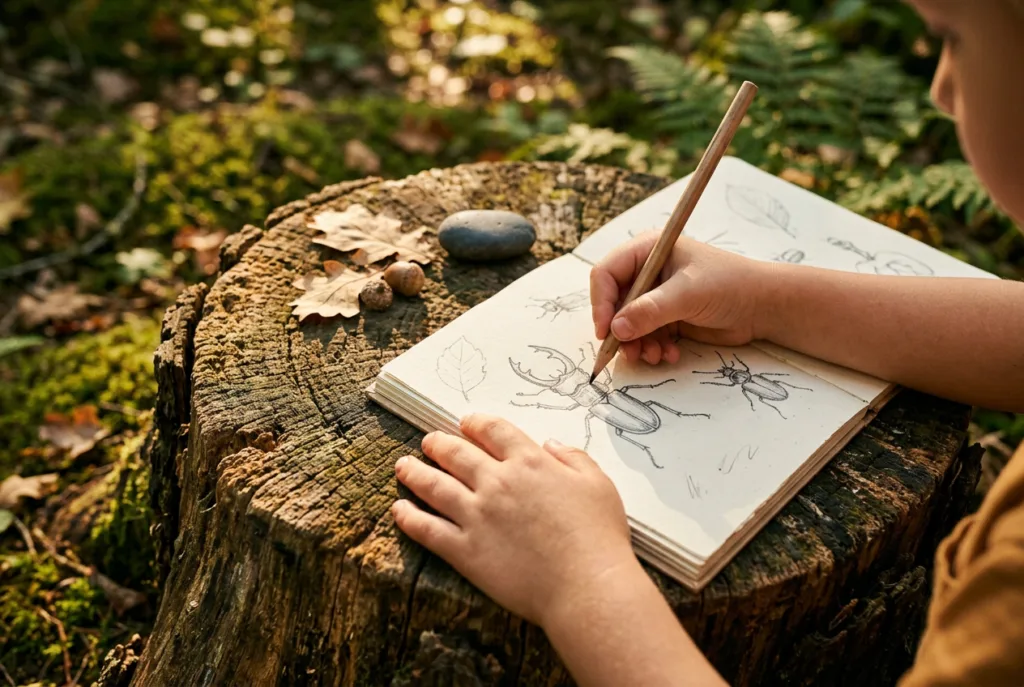
If the words “sit down and write about it” make your kid’s whole body go stiff, you are not alone, and nature journaling might actually be the workaround, not another version of the same problem. It looks like sitting-still schoolwork from the outside. It is not. Done right, it is a walk, a scavenger hunt, and a sketchbook that never has to be neat, all at once.
Why this works when a desk doesn’t
Kids who struggle with traditional seatwork often do better with content that moves them first and asks them to record second. Research on green space and attention backs this up in a specific way. A national study by researchers Ming Kuo and Andrea Faber Taylor found that children with ADHD showed milder symptoms after time in green, outdoor settings, whether that was a backyard, a park, or a stand of trees near a school, according to a summary from CHADD, the national ADHD resource organization (chadd.org). That is not a claim that nature journaling cures anything. It is a reason to expect that kids who fight a desk might settle in faster once their body has already been moving outside.
There is also a learning case for the drawing part specifically. Edutopia reports on a 2018 study finding students who drew science concepts were nearly twice as likely to recall the information later, compared to students who only wrote definitions (edutopia.org). Nature journaling leans on exactly that mechanism. Your child is not writing a report. They are drawing a bug, then labeling it, and the labeling sticks because the drawing came first.
What you actually need
One notebook. One pencil. That’s it to start. Add colored pencils later if your kid wants them, but resist buying a kit before you know if this format clicks. A cheap composition book works as well as anything.
You do not need a nature preserve either. A backyard, a sidewalk crack with dandelions, or the tree outside a library window all count. The point of the practice is close observation, not exotic scenery.
The three questions that carry the whole method
Naturalist and author John Muir Laws, whose guide is one of the most widely used entry points into this practice, frames nature journaling simply as recording your observations, questions, and connections in words, pictures, and numbers, and stresses that you do not need to be an artist or a naturalist to start (johnmuirlaws.com). In practice, most beginner journaling boils down to three open-ended prompts a child can answer about anything they find:
- I notice. What do you actually see? Color, shape, how many legs, is it moving.
- I wonder. What questions does it raise? Why is it doing that, where did it come from.
- It reminds me of. What connection does their brain make? A ladybug reminds them of a stoplight, a spiderweb reminds them of a net.
None of these require good handwriting or good drawing. A kid who draws three scribbly legs and writes “buggy, fast, I wonder why it’s red” has done real nature journaling.
A simple first session, step by step
- Walk first, journal second. Give your child five or ten minutes to just move and look before you ask them to write anything. This is the part that makes the format work for a wiggly kid. The moving is not a break from the learning. It is the first half of it.
- Let them pick one thing. A leaf, an ant, a cloud, a puddle. One object is plenty for a first try.
- Sit or crouch next to the object, not at a table. Journaling on the ground or against a tree keeps the body engaged instead of switching straight into desk mode.
- Ask the three questions out loud if they’re stuck. “What do you notice? What do you wonder? What does it remind you of?” You can write down what they say if writing itself is the sticking point. The observing is the skill you’re building, not the handwriting.
- Stop at five minutes. A short first session that ends while your kid still wants more beats a long one that ends in a fight. You can always go longer next time.
Keeping it low-prep for the long haul
For prompts and short lessons when you want more structure, John Muir Laws and Wild Wonder Foundation publish a free curriculum called “How to Teach Nature Journaling,” with more than 30 ready-to-use activities, plus a free quick-start guide available in multiple languages (wildwonder.org). Neither costs anything and neither requires an art background to use.
If your child likes naming what they find, the free Seek app from iNaturalist uses your phone’s camera to help identify plants and animals on the spot, which turns “I wonder what this is” into an answer they can write down themselves (inaturalist.org).
When it still doesn’t click
Some kids need the object to come to them instead of the other way around. Bring a jar or a magnifying glass on the walk and let them collect one thing to study up close for a minute before it goes back outside. Some kids do better narrating to you while they pace instead of drawing at all. Write what they say and let them add a doodle later, or not. The three questions do not require sitting, drawing, or even much writing. They require noticing. Everything else is optional.
Frequently Asked Questions
How long should a nature journaling session be for a young or wiggly kid?
Start with five to ten minutes of free movement before any writing, then five minutes of journaling. Short and complete beats long and unfinished.
Does my child need to be able to draw well?
No. John Muir Laws’ own guidance is that nature journaling does not require being an artist or a naturalist, only practice.
What if my kid won’t sit still even for five minutes?
Let them journal standing, walking, or narrating out loud while you write it down. The three prompts (I notice, I wonder, it reminds me of) work as spoken answers just as well as written ones.
Is there real research behind outdoor time helping kids focus?
Yes. A national study on green space and ADHD found milder symptoms in children after time in outdoor, natural settings, as summarized by CHADD.
