
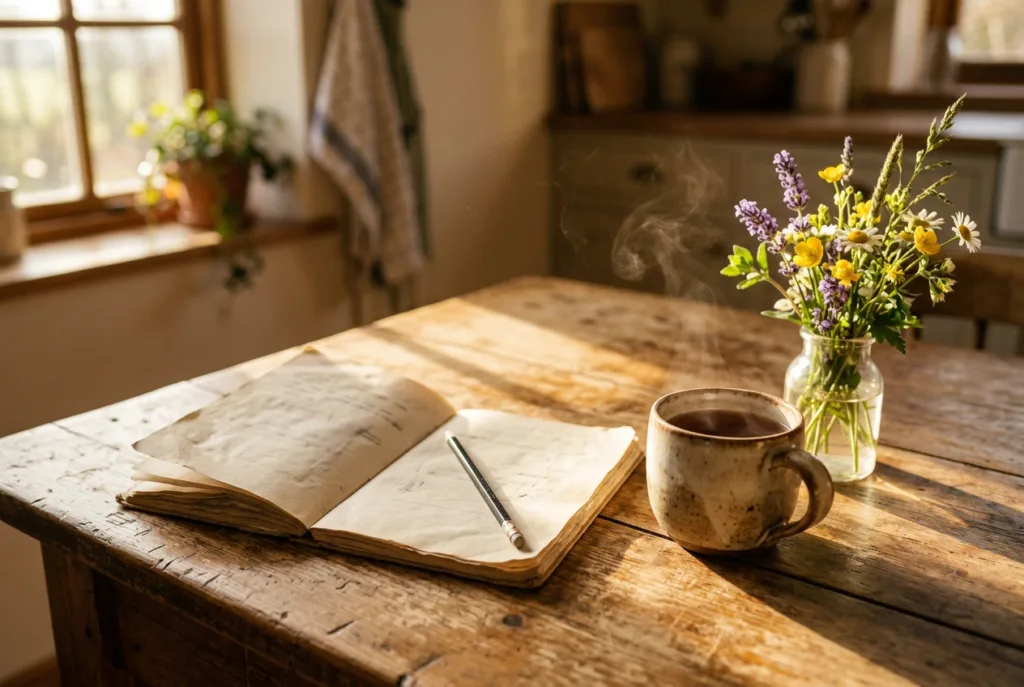
Somewhere between “we do school in our pajamas” and the pastel flatlay of freshly sharpened pencils, there’s a real homeschool day. It has coffee that goes cold. It has a kid who finishes math in twelve minutes and one who cries over it for forty. It has a rhythm, not a bell schedule, and once you stop expecting the bell schedule, the whole thing gets a lot easier to live with.
If you’re new to this and trying to picture what your days will actually feel like, here’s the honest version.
Rhythm, not schedule
Most homeschooling families don’t run on a clock the way a school does. They run on an order: wake up, eat, do the things in roughly this sequence, be done when you’re done. Some days that’s 9am to noon. Some days it’s in three scattered chunks because the baby napped weird or the dishwasher broke. The point of a rhythm is that it bends. A schedule that says “math at 9:15” breaks the first time a kid throws up or a delivery truck shows up early. A rhythm just moves.
This isn’t a technique you have to learn from a course. It’s mostly just giving yourself permission to stop treating 9am to 3pm as sacred.
What the morning actually looks like
Nobody is dressed by 9. Someone is still working through a bowl of cereal while flipping through a math workbook. One kid wants to read out loud for twenty minutes straight and another one wants to be done with everything in eight. You answer a text, you referee an argument about who gets the good pencil, you circle back to the kid who wandered off mid-sentence. It’s not chaos exactly, but it’s not quiet, either.
This is normal. It’s also, in a strange way, closer to how learning research suggests real gains happen than the version most people imagine.
Short lessons work better than long ones
Charlotte Mason, the British educator whose ideas still shape a huge amount of homeschool practice today, built her whole method around short lessons rather than long ones. AmblesideOnline, the free Charlotte Mason curriculum guide, describes her approach as ten to twenty minute lessons per subject for younger children, with an emphasis on focused attention over duration, longer sessions coming later as kids mature. The idea is that a sharp fifteen minutes beats a foggy hour. That’s a big part of why a homeschool morning can look scattered and short and still be doing real work.
How many hours does it actually take?
This is the question almost every new homeschool parent asks, usually with some anxiety attached: are we doing enough? Steven Duvall, PhD, who served as HSLDA’s Director of Research from 2020 to 2025, has written that third and fourth grade homeschool students can spend as little as two to three hours a day on academics and make the same progress kids make across a full public school day. HSLDA points to research by Stanley and Greenwood observing Kansas City fourth graders, which found that out of a 400 minute school day with 250 minutes set aside for instruction, students were actually engaged in productive learning behavior for only about 67.5 minutes total. Two separate studies cited in that same piece found homeschoolers spending two to two and a half times as much of their time actively reading, writing, or discussing material compared to kids in a public school classroom.
None of that is a knock on public schools, which are managing thirty kids at once instead of two or three. It’s just math about what one-on-one or two-on-one instruction can do in less time. It’s also the reason your “short” homeschool day isn’t actually short in the way it feels.
The legal backdrop varies a lot
How much time your state expects you to log, if any, depends entirely on where you live. Some states have no hour or day requirements at all. Others specify a minimum number of instructional hours or days per year. HSLDA maintains a free, state-by-state legal map at hslda.org/legal that walks through what your specific state actually requires, including subjects, testing, and notice rules. It’s worth bookmarking before you build a rhythm, so you know the floor you’re building on top of.
The parts nobody films
There’s laundry sitting in the dryer during “school hours.” There’s a day where you scrap the plan entirely because everyone’s tired and you go to the library instead. There’s the afternoon where a kid melts down over spelling and you both need a break before you get back to it, or you don’t get back to it at all that day. There’s the guilt spiral of comparing your Tuesday to someone else’s nine-second video of a perfect nature walk.
That’s not a sign you’re doing it wrong. It’s what a home-based, kid-paced day looks like when it’s actually being lived instead of staged for a camera.
What actually makes a day work
The families who feel calm about this long-term tend to do a few boring things: they let the youngest play alongside the older kids’ lessons instead of demanding separate instruction time, they let subjects loop through the week instead of hitting every single one every single day, and they let a hard day just end early without treating it as a failure to make up later. None of that is glamorous. It’s also the entire trick.
Sources
- Homeschoolers May Need Less Instructional Time than Traditional School Students, HSLDA, citing research by Steven Duvall, PhD, and the Stanley and Greenwood Kansas City classroom time study
- Homeschool Laws By State, HSLDA’s free state-by-state legal lookup tool
- An Introduction to Charlotte Mason, AmblesideOnline, on short lesson lengths and focused attention for younger children
Frequently Asked Questions
Do I really need to homeschool for six or seven hours a day like public school?
No. Steven Duvall, PhD, who served as HSLDA’s Director of Research from 2020 to 2025, has written that third and fourth grade homeschoolers can spend as little as two to three hours a day on academics and match the progress kids make in a full public school day, based partly on a Stanley and Greenwood study of Kansas City classrooms.
What’s the difference between a homeschool rhythm and a schedule?
A schedule ties activities to specific clock times. A rhythm just sets the order things happen in, so it bends around a bad night’s sleep, a doctor’s appointment, or a meltdown without falling apart.
How do I know what my state actually requires for homeschool hours?
Requirements vary a lot by state, from no hour requirements at all to a set minimum of instructional hours or days per year. HSLDA’s free state-by-state legal map at hslda.org/legal breaks down what your specific state requires.
Why do so many homeschool days use short lessons instead of long class periods?
It follows an approach popularized by educator Charlotte Mason, whose method (described by the free curriculum guide AmblesideOnline) uses ten to twenty minute lessons per subject for younger children, prioritizing focused attention over lesson length.
